Project Brief
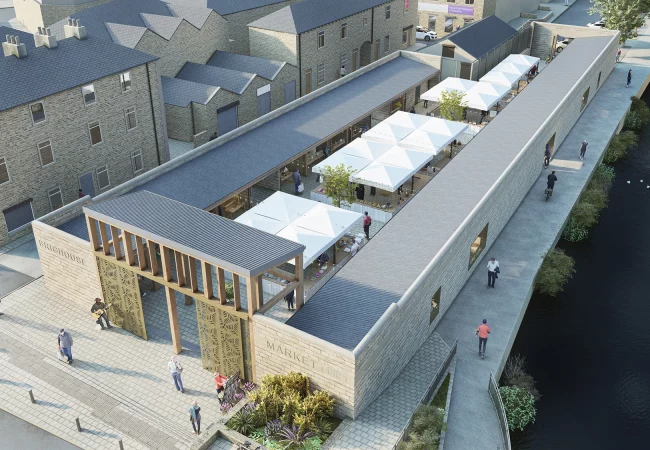
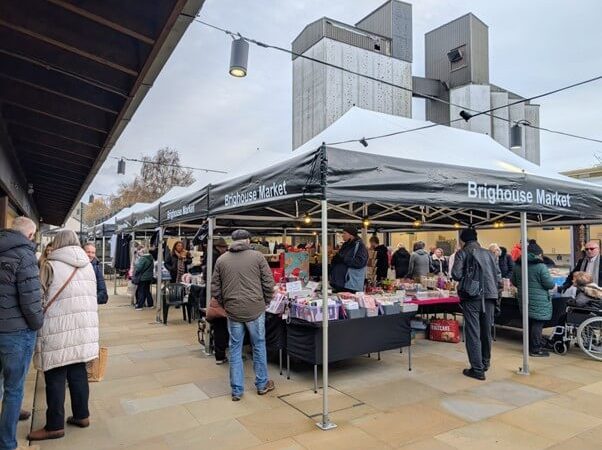
The Brighouse Market redevelopment forms part of a government-funded initiative to revitalise the town and public realm and link canalside heritage with the town centre. The distinctive community space contains 21 fixed market stalls with water, drainage and power, surrounding a flexible central space for events and pop-up stalls. The restricted site is tightly bounded by two roads, the canal towpath, and a public house. Our initial appointment to provide early design advice was extended to full civil and structural engineering design through to site delivery.
Solution
Structures:
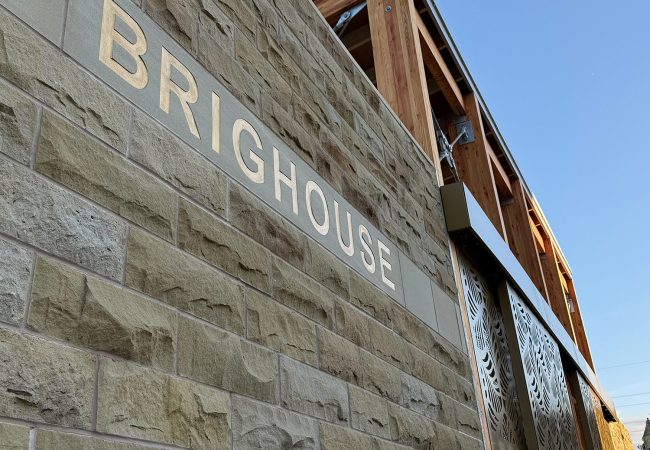
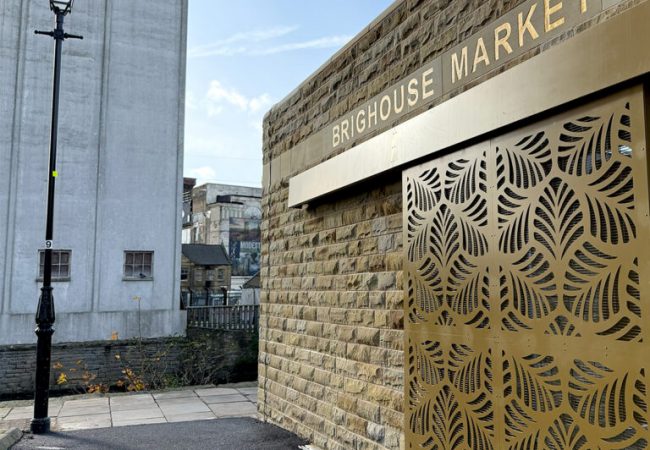
Load-bearing masonry was selected for the permanent stalls and perimeter wall to improve the appearance, security, maintenance, and longevity of the new facility. To successfully discharge planning conditions, we ensured our foundation design would not surcharge the canal wall or undermine adjacent foundations to an existing building and stone boundary walls. The ground floor concrete slabs were cast to nominal falls towards a slot drain to facilitate easier cleaning. We contributed to the landscaping/external works strategy, designing retainment between the market entrance and the canal, and at the rear gate, and helping to secure an AIP agreement for a new planter retaining onto the public footpath. A dramatic, double-height timber-framed structure with steel tendon bracing marks the main entrance. We coordinated with the specialist timber manufacturer to review calculations for the frame design. We checked that loadings from the new decorative metal gates had been applied, reviewed the flitch and baseplate connections, and designed the pad foundations. To avoid creating proprietary connection plates, splice plates were used for the beam-to-column connections. We provided a galvanised steel stub to the base of the timber columns to create a robust fixing point.
Civils:
We worked closely with the LLFA, Yorkshire Water, and the Canals and Rivers Trust to manage the implications of Flood Zone 2. We used surface water drainage modelling and calculations to design suitable attenuation and flow restriction. Floor levels could not be raised without disrupting pedestrian connections to the existing towpath and footpaths, so we incorporated alternative flood resilience measures. These included using water-resistant structural materials, adding a low-level concrete infill within the masonry walls for robustness, ensuring the final built form allows any flood water to recede quickly and easily, and coordinating with M&E to keep power sources and plant 1m above floor level. We secured approval to connect to an existing combined sewer. To avoid diverting existing utilities clashing with the proposed location of new retaining walls, we proactively liaised with Yorkshire Water to obtain a build-over agreement.